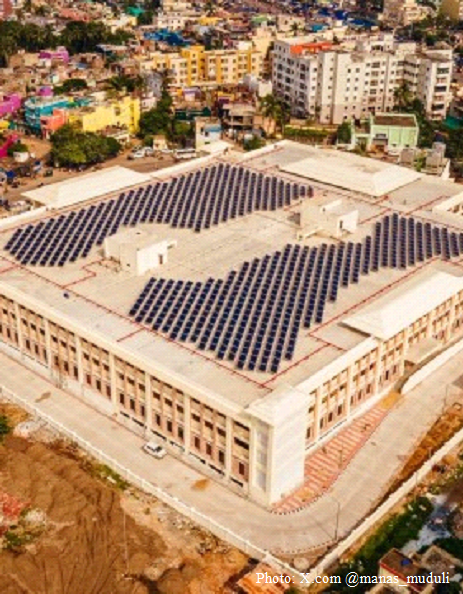
Odisha must conduct deep-down power system analysis Among the Indian states, energy intensity of Odisha economy has always been on the higher side due to her higher resource (mineral) base. The proximity of minerals has led to development of extraction based industries in the state. The abundance of coal resources has fuelled development of coal... Read More
Persistent regional disparities in household illiteracy is hampering India's quest for inclusive development. Household illiteracy in India: The fight against illiteracy has long been a priority for policymakers in India. Education, often hailed as the cornerstone of progress and empowerment, remains central to India’s vision of inclusive growth and development. However, despite significant strides, the battle... Read More
The Companies Act (2013) implemented in 2015 marked a turning point for the presence of women directors in corporate India. This Act required all listed firms to have at least one woman on their board. In a recent paper, Mahima Vasishth, Navya Srivastava, and I looked at the trends of female leadership in corporate India.... Read More
Households, both rural and urban, spent about 13.53 per cent of their annual education expenditure on coaching and tutoring in 2022-23. This is 1.67 percentage points higher than 2011-12. Dependency on coaching to improve academic performance is now common at all levels of education. There was a time when students who sought private tuitions were... Read More
As India sets its sights on Viksit Bharat—a vision of becoming a developed and prosperous nation—one crucial factor could determine the success of this ambitious goal: the full and active participation of women in the workforce. Despite the nation’s significant growth since the economic liberalization reforms of 1991, the decline in female labour force participation... Read More
Constitutional independence alone is not enough. It must be bolstered with strong public accountability and transparency. Emerging market regulators face significant challenges in maintaining their credibility when domestic and external entities level allegations against them. The Hindenburg Report's accusations against the Adani Group and India's Securities and Exchange Board (SEBI) have thrust the integrity of... Read More
The World Bank’s measure of extreme poverty, at $2.15 a day, represents a level of deprivation that is rarely seen in the West. At this income, hunger or its shadow is an inescapable feature of life. Estimates suggest that over half the children born to poor families are undernourished. One could argue that even a... Read More
Expanding the RBI’s mandate or shifting to a discretionary regime could undermine stability and prove counterproductive. India adopted inflation targeting (IT) in September 2016. The government announced a 4 per cent Consumer Price Index (CPI) headline inflation target, within an upper limit of 6 per cent and a lower limit of 2 per cent. The... Read More
There are several challenges but also opportunities. India’s agricultural sector faces challenges, including climate change, land degradation, and market access issues. The Pradhan Mantri Fasal Bima Yojana (PMFBY), introduced in 2016, provides financial assistance for crop losses. With 49.5 crore farmers enrolled and claims totalling over ₹1.45 lakh crore, the scheme is a cornerstone of... Read More
As the global economy fragments along geopolitical lines, countries are seeking new ways to flourish, or at least insulate themselves against geopolitical shocks. Drawing from a newly constructed database, this column explores the concept of ‘connector’ countries, which can be vertical along supply chains or horizontal across markets. The authors argue that vertical connectors may... Read More