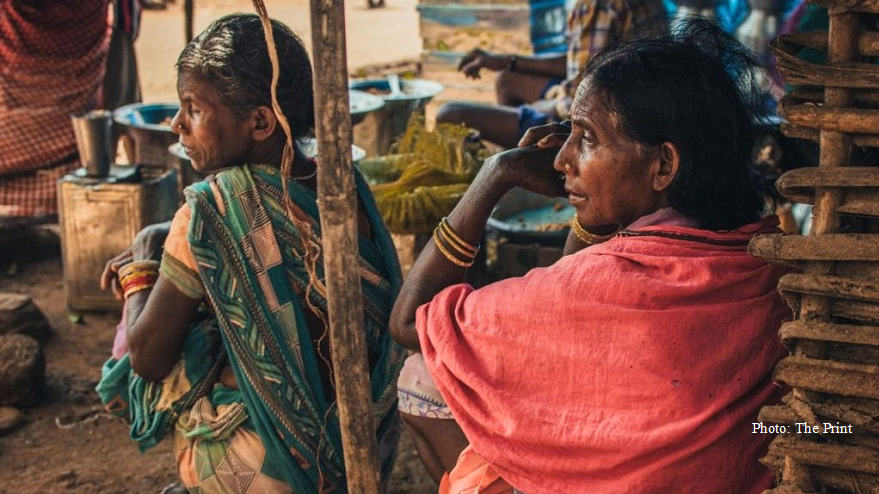

India’s female labour force participation rate remains among the lowest in the world. The reason is the macroeconomic environment, and unpaid work within the household. India has a labour force participation problem that is hard to look away from. Nearly half of all working-age adults – around 49% – are outside the labour force entirely.... Read More
Why do nearly half of working-age adults in India, and three-quarters of women, remain outside the labour force? We address this question using a continuous-time joint household search model calibrated to Indian data. Households pool resources and make employment decisions under gender-asymmetric labour market frictions and unequal home-production responsibilities. Estimated transition rates from the Consumer... Read More
India’s female labour force participation rate remains among the lowest in the world. Based on a structural economic model calibrated to Indian data, this article finds that the reason lies at the intersection of two forces that have largely been studied in isolation – macroeconomic environment, and distribution of unpaid work within the household. Understanding... Read More
On the basis of 55 non-working and 93 working married women residing in urban Delhi, this study compares the motherhood ideology of employed and stay-at-home married women. Drawing on Hays’ (1996) Intensive Mothering Ideology and Blair-Loy’s (2003) notion of ‘competing devotions’, the study categorizes women’s motherhood ideologies into three orientations—traditionalist, ambivalent and ambivalent-progressive—to examine how... Read More
India’s digital expansion over the past decade has been unprecedented. The country’s internet user base grew from roughly 198 million in 2015 to more than 1.03 billion by 2025, driven by affordable smartphones, low-cost mobile data, and rapid expansion in digital infrastructure. Drawing on nationally representative data from the India Human Development Survey (IHDS-III), this... Read More
Every climate conference promises finance. Every time, the money arrives in the wrong form, in the wrong channel and in the wrong magnitude. Now the world is trying again. Last month, the G7 finance ministers reaffirmed their unwavering commitment to climate finance. But the real question isn’t whether climate finance can be raised. It’s whether... Read More
The Code's effects on employment and productivity depend less on its provisions than on how mandates interact with firm size, labour market structure, and worker perceptions of contributions. Social security – the provision of a safety net against retirement, health expenses, and income shocks – is a foundational principle of formal employment. In India, this... Read More
Improving standards compliance, institutional coordination, and farmer-market linkages is critical for enhancing India’s competitiveness in global agri-food trade India stands at a pivotal moment in global agri-food trade. It is among the world’s largest producers of rice, milk, spices, fruits, fisheries, and several horticulture products, yet its share in global agricultural exports remains modest at around... Read More
NCAER News is a monthly digest where you can learn about NCAER's research outputs, its latest events, and offerings.
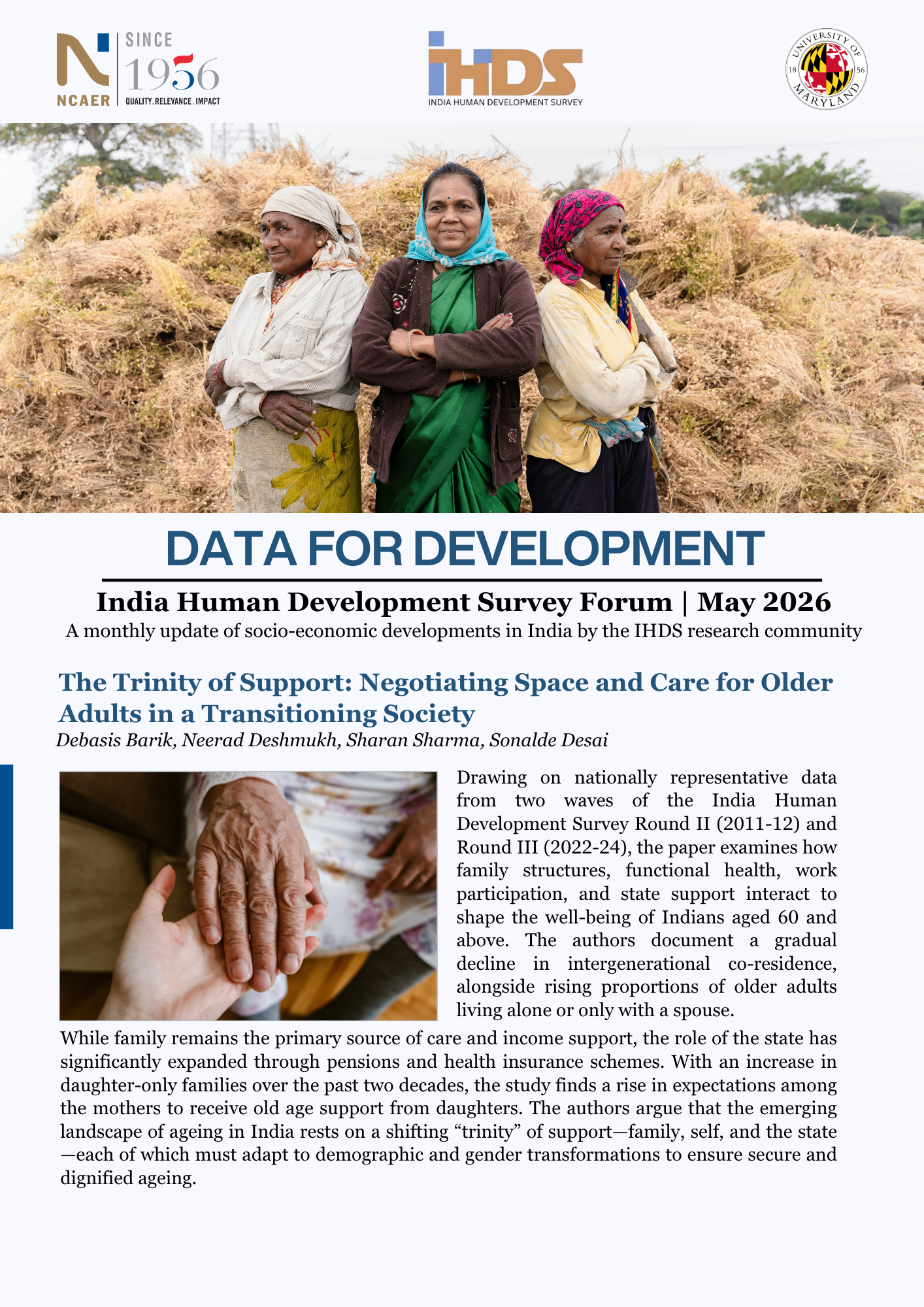
The IHDS Forum is a monthly update of socio-economic developments in India by the IHDS research community, based on the India Human Development Survey, jointly conducted by NCAER and the University of Maryland. While two earlier rounds of the survey were completed in 2004-05 and 2011-12, respectively. Fieldwork for the third round was undertaken in... Read More